A 2026 Predictive Maintenance Technologies IoT and AI Manufacturing Guide
October 20, 202613 min readHina Khan
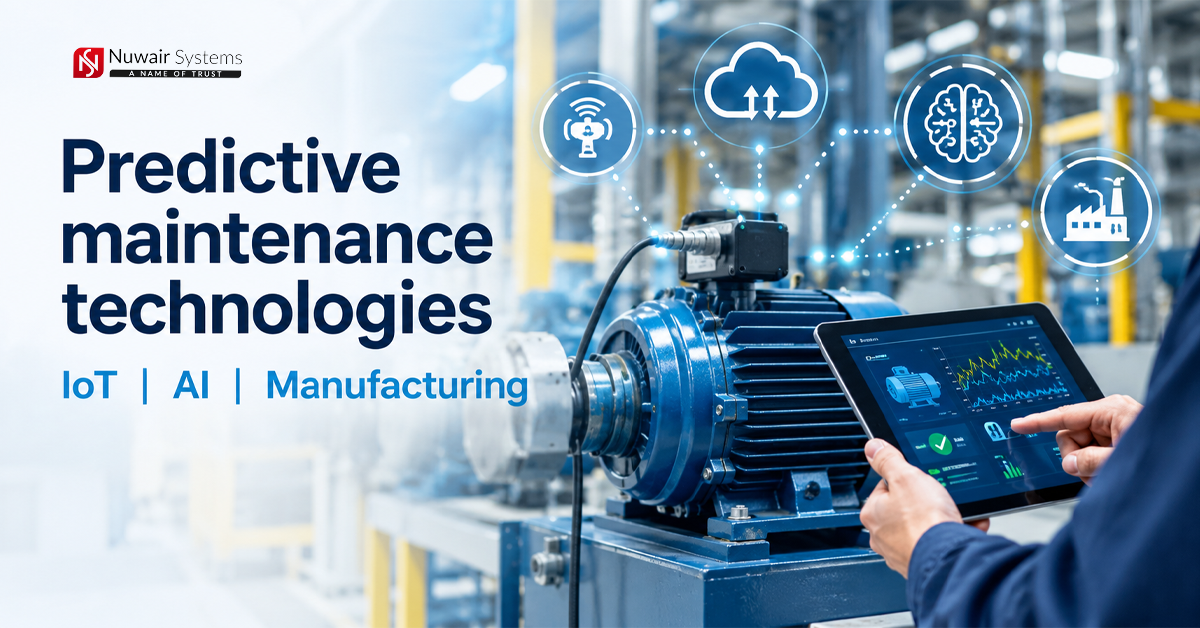
Predictive maintenance technologies let manufacturers spot equipment problems early enough to fix them on their own schedule instead of during an unplanned stop. The idea is simple: sensors measure how a machine is behaving, software compares that behaviour with what is normal, and a maintenance team acts before a failure. The difficulty lies in the details of which sensors, which data, which models, and how alerts work. This guide explains each layer of the technology stack, where AI helps and where it does not, how to build a business case, and how US and Australian manufacturers can roll it out without the usual pitfalls.
1. What Is Predictive Maintenance?
Predictive maintenance uses data from equipment to estimate when a fault is developing, so maintenance happens when it is needed rather than too early or too late. It sits on a spectrum of maintenance strategies, and most plants use several at once.
StrategyHow it worksBest suited to Reactive Fix it after it breaks Cheap, non-critical, easily replaced items Preventive Service on a fixed calendar or run-hours schedule Assets with predictable wear and low monitoring value Condition-based Act when a measured condition crosses a threshold Assets where a simple indicator, such as temperature, shows trouble Predictive Use trends and models to forecast faults and remaining life Critical or expensive assets with detectable degradation Prescriptive Recommend a specific action, timing, and parts, often with AI support Mature programmes with strong data and process integration
A helpful mental model is the P-F curve. A failure usually begins with a detectable sign (the P, or potential failure point) and ends in functional failure (the F). The time between them is the warning window. Predictive maintenance is about detecting P early and making that window long enough to plan the repair. Some failures, such as a sudden electrical fault, give little or no warning, which is why not every asset suits prediction.
2. The Technology Stack briefly
LayerPurposeTypical technologies
Sensing Measure the machine's condition Accelerometers, temperature and current sensors, ultrasonic probes, thermal cameras, oil sensors; existing PLC and SCADA data Edge and connectivity Collect, pre-process, and transmit data Edge gateways, OPC UA, MQTT, wired and wireless industrial networks, private 5G, satellite for remote sites Data platform Store, organise, and contextualise data Time-series databases, data lakes, asset hierarchy models, streaming pipelines Analytics and AI Detect anomalies and forecast failures Statistical rules, machine learning, hybrid physics-and-data models, digital twins Action Turn insight into maintenance work CMMS or EAM integration, work-order automation, dashboards and mobile apps People and process Make sure someone acts, and the system learns Criticality analysis, maintenance planners, feedback on every alert
3. Sensing: Which Technology Finds Which Failure?
The first practical question is what you are trying to detect, because different failure modes show up in different signals. Match the sensing method to the failure mode, not the other way round.
TechnologyDetectsTypical assets Vibration analysis (accelerometers) Bearing wear, imbalance, misalignment, looseness, gear faults Motors, pumps, fans, gearboxes, compressors Temperature and thermography Overheating, friction, electrical hot spots, insulation problems Electrical panels, motors, bearings, switchgear Ultrasonic and acoustic monitoring Leaks, poor lubrication, early bearing faults, electrical discharge Compressed-air and steam systems, bearings, switchgear Oil analysis Wear particles, contamination, lubricant degradation Gearboxes, hydraulic systems, engines Motor current signature analysis Rotor and stator faults, load problems, some mechanical faults Electric motors and driven equipment Pressure, flow, and power data Cavitation, blockages, efficiency loss Pumps, compressors, process lines
Before buying sensors, check what you already have. Many PLCs, drives, and SCADA systems already record motor current, temperature, pressure, and run states that can support a first pilot at little extra cost. Relevant standards include ISO 17359 on condition monitoring, ISO 13374 on condition-monitoring data processing, and ISO 20816 on evaluating machine vibration, which are worth consulting when specifying a programme.
4. Edge Computing and Connectivity
A vibration sensor can produce thousands of readings per second, far more than is sensible to send to the cloud continuously. Edge devices solve this by processing data near the machine. A common approach is to run a fast Fourier transform (FFT) at the edge, turning raw vibration into frequency features that describe the machine's condition, and sending only those features, summaries, and exceptions onward.
Standard protocols keep the system open. OPC UA is widely used to read data from industrial controllers securely, and MQTT is a lightweight protocol well suited to publishing sensor data over limited networks. For remote sites, such as mines, pipelines, and rural facilities, edge processing is often essential because bandwidth is limited and links can drop. Private 5G, long-range wireless, and satellite connections are options where wired networks are impractical, and the edge should keep working and buffer data when the connection is lost.
5. Data Platform and Integration
Sensor data is only useful with context. A time-series database stores the readings, but the platform also needs an asset hierarchy (which sensor belongs to which motor, on which line, in which plant), operating conditions (load, speed, product being run), and maintenance history. Without context, a vibration spike could mean a failing bearing or simply a change of product.
Maintenance history deserves particular attention, because it is the source of your 'labels'. Work orders that record what failed, when, and what was done are what let models learn the link between signals and faults. If those records are vague or inconsistent, improving them is often the highest-value early step. Integrating with the CMMS or EAM system also lets alerts create work orders automatically and lets completed workflows provide feedback.
6. AI and Machine Learning Methods
AI is a toolbox, not a single product. The right method depends on the data you have and the question you are asking.
MethodGood forMain limitation Rules and thresholds Clear limits, such as maximum temperature or vibration severity Cannot catch subtle or combined patterns Statistical monitoring Spotting drift from a healthy baseline Needs a clean, healthy baseline and stable conditions Unsupervised anomaly detection Finding unusual behaviour when few failures have been recorded Flags 'unusual' but not necessarily 'faulty' or why Supervised classification Recognising known fault types Needs plenty of labelled examples of each failure Remaining useful life (RUL) models Estimating time to failure for degrading assets Needs run-to-failure history, which is rare Hybrid physics-and-data and digital twins Combining engineering knowledge with data, useful when failures are scarce Requires modelling effort and domain expertise Generative AI assistants Helping technicians search manuals and past work orders and summarise findings Can be wrong; needs good source data and human oversight
Why AI Projects Struggle
● Few failures: well-maintained machines rarely fail, so there are few examples to learn from, and the data is heavily imbalanced.
● Changing conditions: a model trained on one product, load, or season can raise false alarms when conditions change.
● Model drift: sensors age, equipment is repaired, and processes change, so models need monitoring and retraining.
● Explainability: maintenance teams act on alerts they understand, so models that show which signal changed gain trust faster.
7. From Alert to Action
A prediction creates value only when someone acts on it. Design the path from alert to repair as carefully as the model: define who receives each alert, how urgent it is, who decides on the response, and how the result feeds back. A common failure is alert fatigue, where too many false alarms teach technicians to ignore the system. Tune alert thresholds with the maintenance team, start with fewer, higher-confidence alerts, and record whether each alert was confirmed, so the model and the thresholds improve over time.
Track a small set of measures: unplanned downtime hours, mean time between failures (MTBF), mean time to repair (MTTR), the availability component of overall equipment effectiveness (OEE), maintenance cost, and the programme's own quality indicators, such as how many alerts were confirmed, how many were false, and how much advance warning they gave.
8. Building the Business Case
Instead of relying on generic percentages, build the case from your own numbers. Start with a criticality analysis, ranking assets by the cost and likelihood of their failure, and a failure mode and effects analysis (FMEA) for the top few. Then estimate:
● Cost of unplanned downtime per hour for each critical asset (lost output, labour, scrap, penalties, and expedited parts).
● Hours of unplanned downtime per year, from your own records.
● A realistic share you could avoid (start conservatively, and test it in a pilot).
● Programme costs: sensors, edge devices, platform, integration, security, and the people to run and act on it.
Here is a hypothetical illustration, not a benchmark. Suppose a critical compressor causes 30 hours of unplanned downtime a year at US$20,000 per hour. If a monitoring programme avoids a third of that, the avoided loss is about 10 hours multiplied by $20,000, or $200,000 a year, which you would weigh against the first-year and ongoing programme costs. Your own figures will differ, which is exactly why you should calculate them.
9. Implementation Roadmap
● Step 1: Rank assets by criticality and pick a small set of high-value, well-understood candidates.
● Step 2: Study their failure modes and choose sensing methods that can actually detect them.
● Step 3: Audit existing data (controllers, historians, work orders) and fill the gaps with targeted sensors.
● Step 4: Design the edge, connectivity, and data pipeline, with security and segmentation built in.
● Step 5: Establish a baseline, then start with simple methods such as thresholds and statistical monitoring before adding machine learning.
● Step 6: Integrate alerts with the CMMS or EAM system and agree who acts on each alert type.
● Step 7: Run a time-boxed pilot, measure results against your baseline, and review every alert with the maintenance team.
● Step 8: Scale to similar assets and sites, and add more advanced models where the data supports them.
10. Risks and Pitfalls
● Starting with the technology instead of the failure modes, which leads to sensors that cannot detect the problems that matter.
● Poor maintenance records, which starve models of the labels they need.
● Trying to connect everything at once instead of proving value on a few critical assets.
● Security gaps: connecting operational technology to networks and the cloud widens the attack surface, so segment networks, control access, and follow guidance such as NIST SP 800-82 and the IEC 62443 standards.
● Vendor lifecycle risk: managed services and platforms can change or be retired, so prefer open standards and keep your data portable.
● Neglecting people and process, since technicians must trust and use the alerts.
13. Choosing the Right Technology Partner
Predictive maintenance spans operations, data, and IT. When choosing a partner, look for cloud and edge architecture experience on AWS and Azure, Kubernetes skills for running edge and data workloads, security and DevSecOps practices that cover OT as well as IT, Infrastructure as Code so deployments are repeatable across sites, data engineering depth, and managed IT services to keep pipelines and models healthy after launch. Be wary of partners who lead with a single product before understanding your failure modes.
14. Frequently Asked Questions
What is predictive maintenance?
Predictive maintenance uses equipment data to detect developing faults and forecast failures, so repairs can be planned at the right time instead of after a breakdown or on a fixed calendar.
How does predictive maintenance work?
Sensors and controllers measure machine condition; edge devices and networks collect the data; a platform stores it with context, analytics and AI detect anomalies or forecast failures, and alerts feed into maintenance work orders.
What technologies are used in predictive maintenance?
Typical technologies include vibration, temperature, ultrasonic, current, and oil sensors, edge gateways, industrial protocols such as OPC UA and MQTT, time-series databases, machine learning, digital twins, and CMMS or EAM integration.
What sensors are used for predictive maintenance?
Common choices are accelerometers for vibration, temperature sensors and thermal cameras, ultrasonic probes, current sensors, oil analysis, and pressure and flow sensors. The right one depends on the failure mode you want to detect.
What is the role of AI in predictive maintenance?
AI finds patterns in sensor data that simple rules miss, such as subtle anomalies or combined signals, and can estimate remaining useful life. It works best alongside engineering knowledge and good maintenance records.
What is the difference between predictive and preventive maintenance?
Preventive maintenance follows a fixed schedule regardless of condition. Predictive maintenance acts on the actual condition and forecast of the asset, which can reduce both unnecessary servicing and unexpected failures.
How accurate is predictive maintenance?
It varies widely by asset, data quality, and method. Treat published accuracy and savings figures cautiously, run a pilot, and measure confirmed alerts, false alarms, and warning time on your own equipment.
What data do you need for predictive maintenance?
Sensor and controller data, an asset hierarchy, operating conditions, and maintenance history that records what failed and when. Good records of past failures are especially valuable.
How much does predictive maintenance cost?
Costs depend on the number of assets, the sensors and connectivity needed, the platform, integration, and people. Starting with a few critical assets and existing data keeps the first investment modest.
How long does it take to see ROI?
It depends on how costly the targeted failures are and how quickly alerts become action. Build your own estimate from your downtime cost and avoided hours, and validate it in a time-boxed pilot.
Can small manufacturers use predictive maintenance?
Yes, especially by focusing on one or two critical machines and using existing controller data or low-cost wireless sensors, rather than attempting a plant-wide rollout.
Why do predictive maintenance projects fail?
Common causes are weak maintenance records, too few failure examples, alerts that nobody acts on, trying to do too much at once, and neglecting security and change management.
15. Conclusion
Predictive maintenance technologies work best when you start from the failures that cost you most, match sensors to those failure modes, build a clean data foundation, begin with simple analytics, and make sure every alert leads to a decision. AI adds real power, but only on top of good data and a process people trust. Start small, measure honestly, and scale what works.
Ready to plan your predictive maintenance programme?nuwair.com cloud and edge architecture, Kubernetes, DevSecOps, and managed IT teams can help you build the secure data foundation behind it. Talk to our team to scope your first pilot.