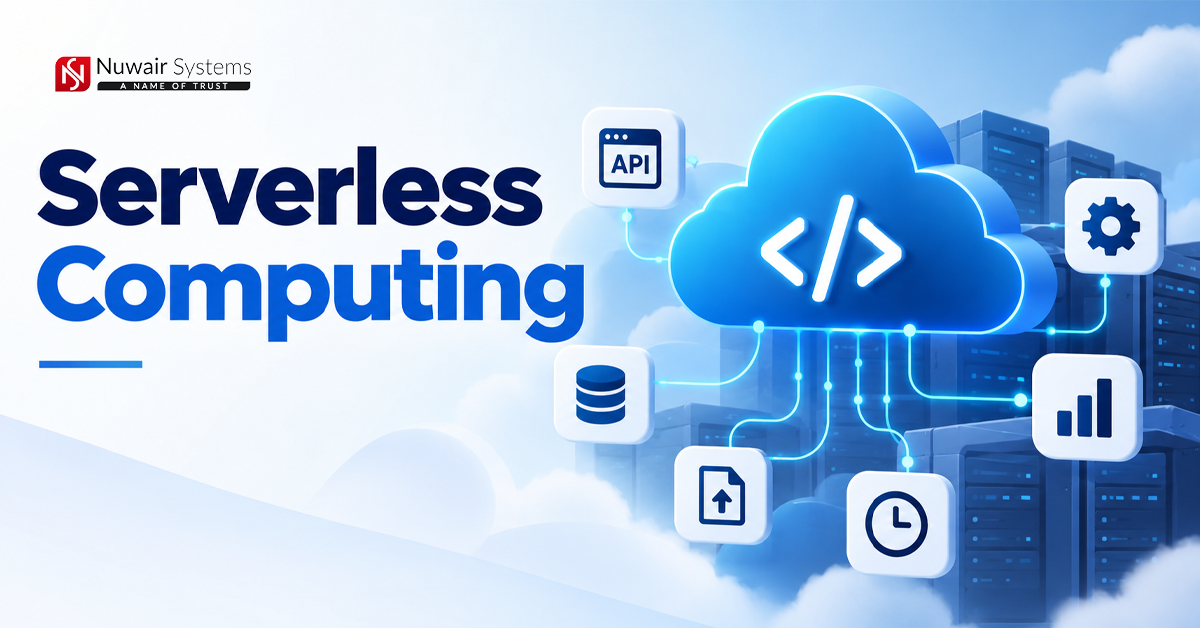
Serverless Computing Overview for Modern Application Developers
October 2, 20269 min readHina Khan
Serverless computing lets developers ship code without provisioning or managing servers; the cloud provider handles scaling, patching, and capacity, and you pay only for the compute you use. It's become a default starting point for a huge range of modern applications, from simple APIs to event-driven data pipelines. This overview covers how serverless works, where it excels, where it doesn't, and what's changed recently that matters for anyone building on it today.
1. What Is Serverless Computing?
Serverless computing is a cloud execution model where the provider automatically manages the infrastructure needed to run your code, allocating resources on demand and charging based on actual usage rather than pre-provisioned capacity. Despite the name, servers are still involved; they're just entirely abstracted away from the developer.
The most common form is Function as a Service (FaaS), such as AWS Lambda, where you deploy individual functions that run in response to triggers such as an HTTP request, a file upload, a database change, or a scheduled timer, and scale automatically from zero to thousands of concurrent executions without any capacity planning on your part.
2. Why Developers Are Choosing Serverless in 2026
The serverless computing platforms market is projected to grow from roughly $13.64 billion in 2025 to $16.42 billion in 2026, a 20.4% compound annual growth rate, according to a February 2026 industry report from The Business Research Company, with continued growth expected through 2030. The pull is straightforward for development teams:
• No server provisioning or capacity planning; the platform scales automatically with demand, including scaling to zero when idle.
• Pay-per-use billing means low-traffic or spiky workloads can cost a fraction of an always-on server.
• Faster iteration: teams deploy individual functions rather than coordinating releases across a monolithic application.
• Built-in high availability and fault tolerance, since the cloud provider manages the underlying infrastructure redundancy.
3. Serverless vs. Containers vs. Traditional Servers
Traditional ServersContainersServerless Scaling Manual or pre-configured auto-scaling Orchestrated (e.g., Kubernetes) Automatic, including to zero Billing Pay for provisioned capacity Pay for running containers Pay per invocation/execution time Ops overhead Highest full server management Moderate orchestration layer to manage Lowest provider manages infrastructure Best fit Predictable, steady-state workloads Complex, long-running, portable workloads Event-driven, variable-traffic workloads
Many modern applications don't pick just one; a common pattern runs core services on Kubernetes for predictable throughput while using serverless functions for spiky, event-driven work like image processing or webhook handling.
4. Core Components of a Serverless Architecture
Functions:small, stateless units of code that execute in response to a trigger and terminate when finished, forming the compute layer of the architecture.
Triggers and events:the mechanisms — HTTP requests via an API gateway, file uploads, queue messages, scheduled timers that invoke a function.
Managed backend services:databases, authentication, storage, and messaging delivered as managed services (often called Backend as a Service, or BaaS) rather than self-hosted infrastructure.
Observability tooling:distributed tracing and logging purpose-built for short-lived, highly concurrent function executions, since traditional server monitoring assumptions don't map cleanly onto serverless.
5. Solving the Cold Start Problem
A cold start happens when a function hasn't run recently, and the platform needs to initialise a fresh execution environment before handling the request, historically adding anywhere from a few hundred milliseconds to several seconds of latency, particularly for JVM-based runtimes with heavier startup overhead.
This has been an active area of platform investment. As of September 2026, AWS Lambda extended SnapStart, which takes a cached snapshot of an initialised execution environment and resumes from it instead of starting from scratch, to functions packaged as container images, cutting startup times from several seconds down to sub-second for workloads that previously had to accept slower starts to use larger, containerised dependencies.
• Use SnapStart (where supported) for the biggest cold-start improvement with no code changes for most functions.
• Use provisioned concurrency for latency-critical functions where even sub-second variability isn't acceptable, accepting the added cost.
• Keep function packages lean and minimise heavy initialisation code to reduce cold start duration further.
6. Common Serverless Use Cases
• REST and GraphQL APIs with variable or unpredictable traffic patterns.
• Event-driven data processing, image or video processing triggered by uploads, ETL pipelines triggered by new data arriving.
• Scheduled and background jobs, such as nightly reports or cleanup tasks, without maintaining an always-on server.
• Webhook handlers and integration glue between SaaS platforms.
• Lightweight AI/ML inference endpoints, particularly where request volume is spiky rather than constant.
7. Building Your First Serverless Application
Identify a workload with variable or event-driven traffic as a good first serverless candidate, rather than a steady, high-throughput service.
Choose a runtime and framework (AWS Lambda with a framework like AWS SAM or the Serverless Framework is a common starting point).
Design functions to be small, stateless, and single-purpose rather than one large monolithic function.
Connect managed backend services (database, auth, storage) rather than self-hosting supporting infrastructure.
Set up observability, distributed tracing, and structured logging before you need to debug a production issue.
Load test to understand real-world cold start behaviour and decide whether SnapStart or provisioned concurrency is needed for latency-sensitive paths.
8. Serverless Costs: Pricing Models and Pitfalls
Serverless pricing is typically based on the number of invocations, execution duration, and memory allocated, which can be dramatically cheaper than an always-on server for low or spiky traffic, and more expensive than a right-sized server for sustained, high-volume, predictable workloads.
The most common cost pitfall isn't the per-invocation price; it's cost sprawl: dozens or hundreds of functions accumulating without clear ownership or monitoring. Treating serverless cost governance as part of the architecture from day one, not an afterthought, avoids the same kind of budget surprise that has become common in broader cloud spend management.
9. Security and Compliance Considerations (US & Australia)
United States
US teams building serverless applications commonly apply the AWS Well-Architected Framework's security pillar, along with least-privilege IAM roles scoped per function rather than shared broadly, and pursue SOC 2 Type II attestation where the application handles customer data.
Australia
Australian businesses need to factor the Privacy Act 1988 and Notifiable Data Breaches scheme into serverless data-handling design, particularly around where managed backend services store data. ISO/IEC 27001 remains a common voluntary framework businesses in both markets use to demonstrate serverless application security posture to partners and auditors.
10. Choosing a Serverless Partner or Platform
For teams without deep in-house serverless experience, a managed provider can shorten the path from architecture decision to production considerably, handling function design, observability setup, cost governance, and security hardening rather than learning each through trial and error in production.
Conclusion
Serverless computing isn't the right architecture for everything, but for event-driven, variable-traffic workloads it removes an entire category of operational burden, and recent platform improvements like SnapStart's expansion into container image functions are steadily closing the gap on its historical weak point, cold starts. The teams getting the most value treat it as one tool in a broader architecture, pairing it with containers where steady throughput matters, and building cost and security governance in from the start rather than after the first surprising bill.
If you're weighing serverless for a new application or inherited a serverless setup that's grown past what anyone's tracking, Nuwair Systems can review your architecture and design a serverless approach built on AWS best practices.Start with a Serverless Architecture Review with us
FAQ Section
What is serverless computing?
Serverless computing is a cloud execution model where the provider automatically manages the infrastructure needed to run your code, scaling resources on demand and charging based on actual usage rather than pre-provisioned capacity.
How does serverless computing work?
Code is deployed as functions that run in response to triggers such as HTTP requests, file uploads, or scheduled timers. The cloud provider allocates resources to run the function, scales automatically with demand, and bills based on invocations and execution time.
What is a cold start in serverless computing?
A cold start is the added latency when a function hasn't run recently, and the platform needs to initialise a fresh execution environment before handling the request. Recent features like AWS Lambda SnapStart for container images significantly reduce this delay.
Is serverless computing cheaper than traditional servers?
Often, yes, for variable or low-traffic workloads, since you pay only for actual usage. For sustained, high-volume, predictable traffic, a right-sized traditional server or container setup can be more cost-effective.
What is the difference between serverless and containers?
Containers package an application with its dependencies and typically run continuously, requiring an orchestration layer like Kubernetes to manage scaling. Serverless functions run only in response to triggers and scale automatically, including down to zero, with no server management required.
What is Function as a Service (FaaS)?
FaaS is the most common form of serverless computing, where developers deploy individual functions that execute in response to events, rather than deploying and managing a full application server.
Which cloud provider is best for serverless computing?
AWS Lambda, Azure Functions, and Google Cloud Functions are the major options; the right choice usually depends on which cloud platform the rest of your infrastructure already runs on.
Is serverless computing secure?
It can be highly secure when built with least-privilege access controls and a recognised framework such as AWS Well-Architected, since the cloud provider handles infrastructure-level patching and hardening that would otherwise fall to your team.
Can serverless computing handle enterprise workloads?
Yes, particularly for event-driven and variable-traffic components of enterprise applications; sustained high-throughput enterprise workloads are often better served by containers or traditional servers, and many enterprises use a mix of both.
What are the downsides of serverless computing?
Cold start latency (though improving), potential cost sprawl without governance, less control over the underlying runtime environment, and a degree of vendor lock-in to the provider's specific function platform and event model.