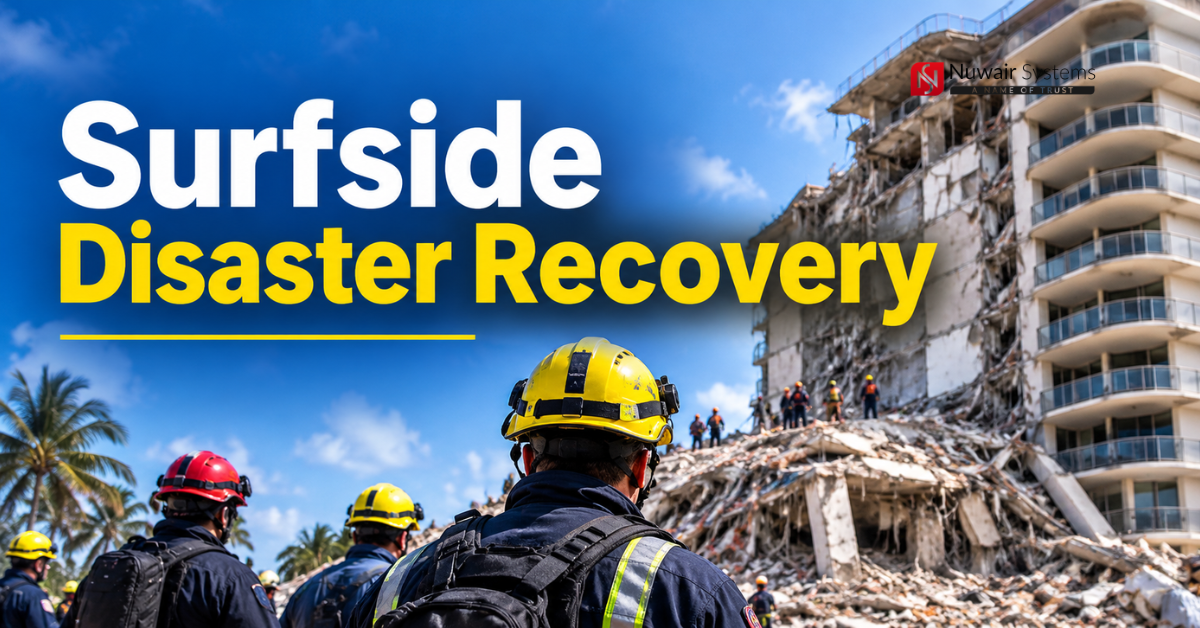
On June 24, 2021, the Champlain Towers South condominium in Surfside, Florida, partially collapsed in the early hours of the morning, and 98 people lost their lives. For emergency responders, the weeks that followed became one of the most closely studied building-collapse operations in recent US history. This guide summarizes the Surfside disaster recovery lessons, also known as the Surfside collapse lessons learned, that responders and officials have shared publicly, from command structure to responder wellbeing. It draws on published accounts and official sources, and it is written with respect for the victims, their families, and everyone who searched for them.
What Happened at Champlain Towers South
At 1:22 a.m., the 12-story, 136-unit oceanfront building partially collapsed. Part of the tower remained standing, while the rest fell into a dense pile of debris. Before the collapse, callers to 911 reported warning signs such as water in the parking garage, banging noises, and a sounding fire alarm. Miami-Dade Fire Rescue (MDFR) led the response as the authority having jurisdiction.
Fortunately, crews rescued survivors in the first hours. According to a presentation by a former MDFR chief, 35 people were removed alive, most of them from the section of the building that was still standing. After those early hours, searchers found no further survivors. The operation moved from rescue to recovery during its 28th operational period, and the last victim was recovered 29 days after the collapse.
What Have Investigators Found?
The National Institute of Standards and Technology (NIST) released its technical findings on June 22, 2026. It concluded that the failure most likely began in early June 2021, about three weeks before the collapse, when two connections between garage columns and the pool deck slab failed. NIST also said the margins against failure were too narrow from the start. The agency is now writing a final report with recommendations for codes, standards, and practices. Because that report was still in preparation at NIST's latest update, check NIST directly for its current status.
The First Hours: Size-Up, Rescue, and Command
The first-arriving company officer sized up the scene and declared a mass casualty incident. That declaration triggered notification of Florida's State Warning Point, which activated state fire and search-and-rescue coordination almost immediately. Meanwhile, company officers sent crews into a damaged building without the immediate advice of structural engineers on the risk of a second collapse. Many trapped residents were brought down from balconies by aerial ladders.
About 100 units were on scene during the initial response. MDFR then assembled a Type III Incident Management Team and formed a unified command. Partners included local and county government, police, the medical examiner, the State of Florida, and federal agencies such as FEMA. In short, early decisions in these first hours shaped everything that followed.
Seven Surfside Collapse Lessons Learned for Emergency Responders
1. Ask Early for Specialized Teams and Heavy Equipment
The two local urban search and rescue (USAR) task forces could not sustain around-the-clock work for what might be weeks. Therefore, command requested the six remaining Florida task forces, which deployed in phases over 36 hours, and notified the national USAR system. Requests for large cranes and a demolition excavator with a hydraulic gripping attachment were also made on the first morning. Even in a resource-rich region, early requests helped avoid potential delays.
In addition, responders stressed reflex time. Specialized teams often travel from far away and need hours to arrive, unload, and become operational. Skilled equipment operators also matter just as much as the machines themselves.
2. Scale Command Support Before It Is Overwhelmed
Florida's initial state oversight team for fire and search-and-rescue coordination had only two people, and it was quickly overwhelmed by the needs of multiple task forces on one compact site. As a result, command asked FEMA for a USAR Incident Support Team. That team of specialists handled USAR operations, planning, logistics, and communications, while the incident management team ran the overall incident. The lesson is simple: plan support staffing for the size of the operation, not the size of the first request.
Florida's statewide response plan itself grew out of lessons from Hurricane Andrew in 1992, when help arrived faster than anyone could house, feed, or coordinate it. Surfside showed the value of that earlier planning.
3. Keep Safety Systems Simple and Consistent
First, responders treated the remaining structure as a no-go area. They also set a 40-foot exclusion zone against falling debris and expanded it to 100 feet after a rescuer reported sounds of structural movement. Structural engineers watched the building around the clock, using surveying instruments that detect tiny shifts, increasing from two instruments to four.
However, the after-action review also found room to improve. Two separate evacuation plans, one for collapse and one for weather, caused confusion when the collapse alarm sounded. Whistles used by safety officers could also be mistaken for those used by equipment operators. The recommended fix was one evacuation plan for all hazards and air horns for all safety signals. Despite the risks, the operation recorded no significant injuries among rescue and support personnel.
4. Plan for Weeks, Not Hours
More than 400 search and rescue personnel eventually worked the 1.4-acre site. To limit exposure to South Florida heat, crews worked 12-hour shifts running midnight to noon and noon to midnight. Within each shift, five-person squads worked on the pile for 30 to 45 minutes before rotating out to decontamination and rest.
Meanwhile, logistics mattered as much as tactics. When space for hundreds of rescuers ran short, a cruise line offered a ship to house 400 to 500 of them. The state also arranged a rental contract for breaching and breaking tools, with technicians on site to repair them. Eventually, five federal task forces replaced most Florida teams in a phased handover, and the two local teams rotated through two or three days of rest each.
5. Support Responder Mental Health from Day One
In what Florida's response coordinator described as a first, mental wellness professionals were deployed through the statewide response plan. They were on the ground around the clock less than three days after the collapse. Their work covered first responders, the family notification center, and daily support for rescue crews. A published case report on the response also notes that prolonged disasters place significant emotional strain on responders. One of the hardest moments, officials have said, was the shift from searching for survivors to recovering victims.
If you or someone you know is struggling after a critical incident, contact your agency's peer support program or a qualified mental health professional.
6. Respect for Culture, Faith, and Families
Surfside has a large Orthodox Jewish community, and many residents of the building were Jewish. Recovery procedures were adapted to honor religious customs, including how remains and surrounding material were removed. This added time to each recovery, and rescuers adapted to respect the plan.
An Israeli rescue team arrived early with 12 members, later growing to 15. Its investigators interviewed the families of missing people in detail, supported by colleagues working remotely, and used that information to map where individuals might be found. In addition, officials used a mobile mapping tool to show families how much ground was searched each day, which helped address worries that not enough was being done. At the transition from rescue to recovery, work paused so families and clergy could gather with the crews.
7. Use Technology and Records Deliberately
For example, several technology choices proved valuable at Surfside. Teams used the Survey123 app to record victims’ locations, hazards, and searched areas. Surveying instruments gave engineers early warnings of structural movement. A pre-set notification rule for mass casualty events activated state resources quickly.
Our analysis: these tools also show how much incident decision-making depends on accurate, shared data. Agencies can ask whether their mapping, dispatch, and documentation systems would keep working during a network or cloud outage. They can also confirm that backups are tested and that incident records are preserved for after-action reviews and investigations. For example, investigators later recovered computer hard drives from the site that might hold useful evidence. These are our suggestions, not findings from Surfside reviews. Our disaster recovery services cover this kind of planning for IT systems.
What Australian Agencies Can Take From Surfside
Every Australian state has a local USAR capability, and two teams are internationally classified as heavy: Australian Task Force 1 from Queensland and Australian Task Force 2 from New South Wales. Command arrangements and terminology differ from the US system, so each agency should adapt these lessons to its own doctrine. Even so, the themes travel well because they are universal: escalate early, add command support, plan for long operations, protect responder wellbeing, and engage the affected community.
A Practical Checklist for Responder Agencies
Next, use the lessons above to review your own plans. A short checklist can turn them into action:
Define escalation triggers. Decide in advance which incidents prompt early requests for specialized teams and heavy equipment.
Write reflex time into plans. Include realistic travel and setup times for resources that are not nearby.
Exercise unified command. Practice with police, medical examiners, emergency management, and state and federal partners.
Standardize safety signals. Use one evacuation plan and one signal set across all hazards and agencies.
Plan for duration. Prepare shift patterns, base camps, resupply, and relief rotations for operations lasting weeks.
Build a well-being plan. Arrange peer support and mental health professionals before they are needed.
Prepare cultural liaisons. Identify community leaders and faith contacts who can advise during recovery and family support.
Protect your data. Test backups, offline access, and records retention for mapping, dispatch, and documentation systems.
Sources and Further Reading
This article summarizes publicly available material. For operational detail, read the original sources:
On June 24, 2021, at 1:22 a.m., the 12-story Champlain Towers South condominium in Surfside, Florida, partially collapsed. Ninety-eight people died, and a large multi-agency search and rescue operation followed.
How many people died in the Surfside collapse?
Ninety-eight people died. According to a presentation by a former MDFR chief, rescuers removed 35 people alive in the early hours.
What caused the Surfside collapse?
NIST's June 2026 findings say the failure most likely began about three weeks before the collapse, when two connections between garage columns and the pool deck slab failed. NIST is still preparing its final report and recommendations.
How long did the search and rescue operation last?
The search for survivors transitioned to recovery during the operation's 28th operational period, and the last victim recovered 29 days after the collapse.
What is urban search and rescue (USAR)?
USAR is a specialized capability to locate, stabilize, and remove people trapped in collapsed structures. Task forces include rescuers, engineers, search dogs, medical staff, and logistics specialists.
What is an Incident Management Team?
An Incident Management Team is a trained group that supports local command on complex incidents by handling operations, planning, logistics, and administration. At Surfside, a Type III team formed a unified command with partner agencies.
What were the main lessons for emergency responders?
Key lessons include requesting specialized resources early, scaling command support, simplifying safety signals, planning for weeks-long operations, supporting responder mental health, and respecting community customs.
Why did rescuers work overnight shifts at Surfside?
Command used 12-hour shifts from midnight to noon and noon to midnight to limit crews' exposure to heat and humidity during the hottest part of the day.
How did officials support the families of those missing?
Officials set up a family assistance center, adapted recovery procedures to religious customs, and showed families the areas searched each day using mapping tools.
Is NIST's final report on the collapse available?
As of NIST's latest update that we found, from August 2026, the final report with recommendations was still being written. Check the NIST website for the status.
Conclusion
The Surfside disaster recovery lessons are practical ones: ask early, scale command support, keep safety signals simple, plan for weeks, protect responders' wellbeing, and treat families and communities with respect. Each lesson came at a high human cost, and the best way to honor those lost is to use them.
Nuwair Systems is an IT services company, not an emergency-operations authority, so please follow your own agency's doctrine and training. If your organization is reviewing how its records, communications, and systems would keep working during a major event, our disaster recovery services team is happy to talk. You can contact us at any time.