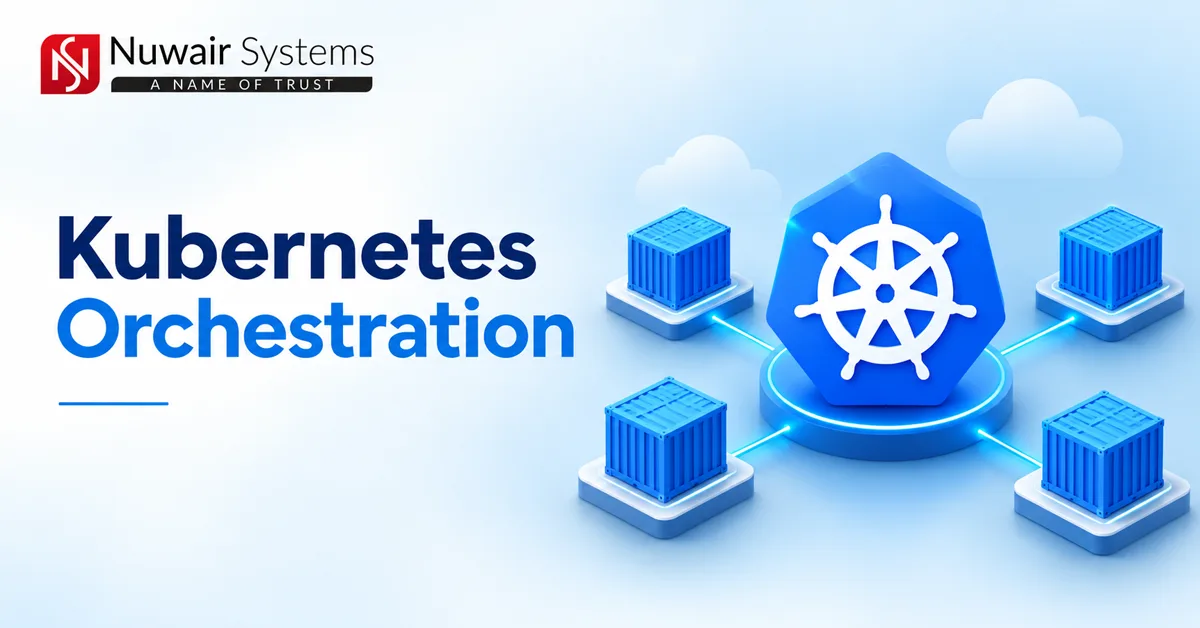
Kubernetes orchestration is the automated process by which Kubernetes deploys, scales, networks, heals, and updates containerized applications across a cluster of machines. Instead of an engineer manually starting, stopping, and monitoring every individual container, teams simply declare the desired state of their application: how many copies should be running, how much CPU and memory each needs, how they should communicate, and Kubernetes continuously works to keep the actual infrastructure matching that declaration.
This shift from manual, imperative server management to automated, declarative orchestration is precisely why Kubernetes has become the dominant standard for running containerized applications at scale: current CNCF ecosystem research puts Kubernetes at roughly 92% market share among container orchestration tools, with the large majority of organizations now using, piloting, or evaluating it in production.
How Kubernetes Orchestration Works
• Kubernetes controls the smallest deployable unit called Pods, which is a set of containers.
• There are physical or virtual machines in a cluster called Nodes that run Pods.
• Kubernetes schedules Pods on available Nodes based on the resource requirements.
• If a Pod or Node fails, Kubernetes automatically creates replacement Pods elsewhere in the cluster. This is the self-healing behavior that underpins Kubernetes' reliability.
• Rolling updates let you deploy new application versions gradually, with zero downtime. And roll back automatically if something goes wrong.
• Namespaces let different teams run isolated environments within the same cluster. So one team can deploy independently without needing to coordinate with every other team on the platform.
Why Businesses Are Adopting It in 2026
The operational case for Kubernetes comes down to a simple shift: engineering teams stop manually babysitting servers and start shipping features faster through modern, automated delivery practices. Enterprises in particular see compounding benefits: consistent operations across environments reduce configuration drift, built-in self-healing improves uptime, and standardized deployment workflows mean new applications ship faster without reinventing infrastructure each time.
Kubernetes has also become the default orchestration layer for AI and machine learning workloads, where flexible compute orchestration, GPU clusters, batch jobs, and scalable inference services are essential. Organizations building AI-driven platforms increasingly rely on Kubernetes specifically because it manages this kind of variable, resource-intensive workload efficiently across both cloud and on-premises environments.
Kubernetes vs the Alternatives
OptionBest ForTrade-off Kubernetes Complex applications, 10+ microservices, multi-cloud portability Real learning curve; teams typically need 2–4 months to reach stable production deployments Docker Swarm Small deployments, edge computing, simpler operational needs Far less market adoption and a narrower feature set than Kubernetes Serverless platforms Simple, stateless applications with unpredictable or bursty traffic Less control over infrastructure; can become costly at sustained high scale Managed Kubernetes (EKS, GKE, AKS) Teams wanting Kubernetes without managing the control plane themselves Still requires in-house or outsourced expertise to operate well
Real-World Use Cases
• Finance — running mission-critical applications that demand real-time processing, high availability, and strict regulatory compliance.
• AI/ML platforms — orchestrating GPU resources and large-scale training or inference workloads across cloud and on-premises infrastructure.
• E-commerce — handling unpredictable traffic spikes during peak shopping periods without manual scaling intervention.
• SaaS platforms — running dozens of independent microservices with isolated, self-service deployment pipelines per team.
Do You Actually Need Kubernetes?
Kubernetes is not the right starting point for every business. It makes the most sense when you're running more than around ten microservices, need multi-cloud portability, or have or plan to build a DevOps team with the capacity to manage cluster operations. If your application is simple, your team is small, or the cost of managing the platform would outweigh the reliability benefits, a managed app platform or serverless option is usually the simpler, more cost-effective choice. One of the most common infrastructure mistakes is adopting Kubernetes because it's trending, rather than because the workload genuinely demands it.
Common Adoption Mistakes
• Overcomplicating the initial setup by implementing every Kubernetes feature on day one instead of starting lean.
• Skipping resource limits — without defined CPU/memory limits, one container can starve others on the same node.
• Adopting Kubernetes before the team has the operational capacity to manage it, leading to reliability problems rather than improvements.
• Overprovisioning out of fear of outages, then never revisiting utilization — this becomes a permanent, unnecessary cost.
• Treating Kubernetes as a one-time project rather than an ongoing platform that needs monitoring, right-sizing, and governance.
4. Frequently Asked Questions
What is Kubernetes orchestration?
The automated process Kubernetes uses to deploy, scale, network, heal, and update containerized applications across a cluster, based on a declared desired state.
How does Kubernetes differ from Docker?
Docker packages applications into containers; Kubernetes manages and orchestrates many containers across multiple machines, handling scaling, networking, and recovery automatically.
Do small businesses need Kubernetes?
Usually not right away — Kubernetes tends to make sense once you're running multiple microservices or need multi-cloud flexibility; smaller, simpler applications are often better served by managed platforms or serverless options.
What are the main benefits of Kubernetes for a company?
Faster, more reliable deployments, automatic recovery from failures, efficient resource utilization, and consistent operations across development, staging, and production environments.
How much does it cost to run Kubernetes in production?
Costs depend on cluster size, cloud provider, and whether you self-manage or use a managed service — the bigger cost driver for most teams is the engineering time needed to operate it well, not the infrastructure itself.
Is Kubernetes hard to learn?
It has a genuine learning curve — teams new to containers typically take two to four months to reach stable, confident production deployments.
What's the difference between Kubernetes and serverless computing?
Serverless abstracts infrastructure away entirely and charges per execution, which suits simple, bursty workloads; Kubernetes gives you more control and is better suited to complex, sustained, multi-service applications.
When should a business avoid Kubernetes?
When the application is simple, the team lacks operations capacity, or the overhead of managing the platform outweighs the reliability benefits it would provide.
How does Kubernetes achieve zero-downtime deployments?
Through rolling updates, which gradually replace old application instances with new ones while keeping the service available throughout, and can roll back automatically if a problem is detected.
What is a Kubernetes cluster made of?
A set of nodes (machines) that run pods (groups of containers), coordinated by a control plane that schedules workloads and maintains the desired state.
Can Kubernetes run on any cloud provider?
Yes — Kubernetes is cloud-agnostic and runs on major providers like AWS, Google Cloud, and Azure, as well as on-premises, which is part of why it supports multi-cloud strategies.
What is self-healing in Kubernetes?
When a container or node fails, Kubernetes automatically detects the failure and creates replacement pods elsewhere in the cluster to maintain the declared desired state.
Conclusion
Kubernetes orchestration has become the default way serious, scaling applications are run in 2026, but that doesn't mean every business needs it today. The businesses that get the most value are the ones that adopt it because their workload genuinely demands it, not because it's the trend, and that pair the platform with the operational discipline to run it well: resource limits, right-sizing, and ongoing governance rather than a one-time setup.
Evaluating whether Kubernetes is right for your infrastructure? Nuwair Systems designs and manages Kubernetes clusters for startups and enterprises alike. Get in touch for a free architecture consultation.