Article
What Is IIoT and Why It Matters
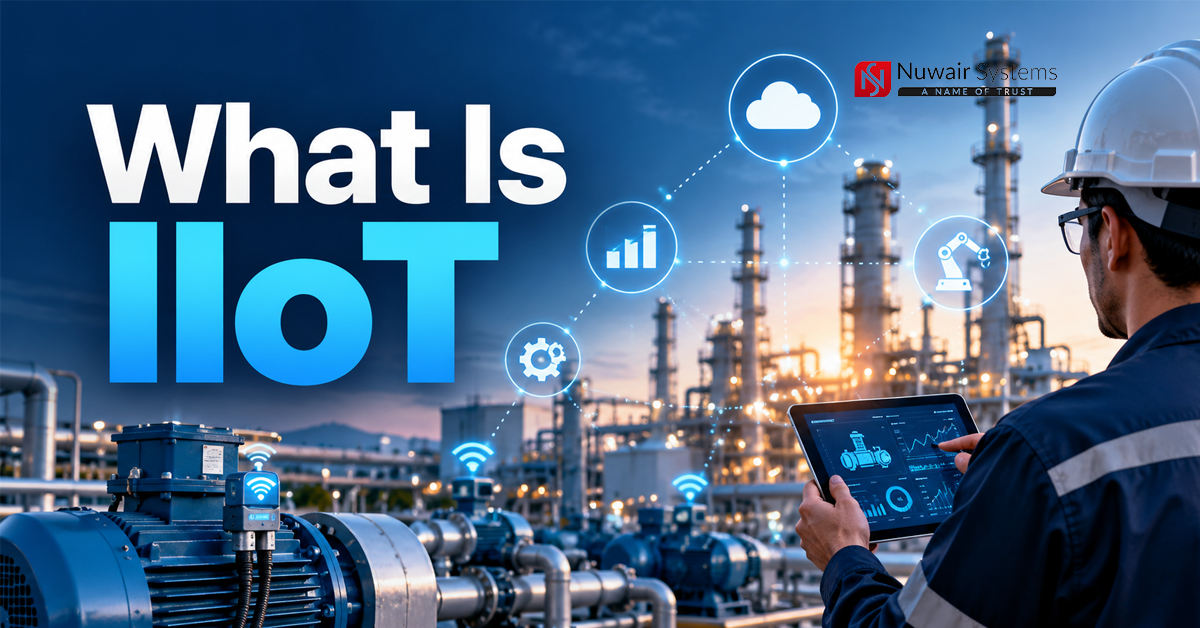
What Is IIoT?
The Industrial Internet of Things connects physical industrial assets, such as machines, vehicles, pipelines, and production lines, to networks and software so that their data can be monitored, analysed, and acted on. Think of it as a nervous system for a plant or a fleet: sensors feel what is happening, networks carry the signals, and software decides what to do.
Here is a simple example. A water pump in a treatment plant has a vibration sensor attached. The sensor sends readings every few seconds to a local gateway, which forwards them to an analytics platform. The platform learns what normal vibration looks like. When the pattern starts to drift, it flags the pump for inspection weeks before it fails, so maintenance is planned instead of an emergency. That is IIoT in one scene: data from a machine becoming an early warning.
IIoT vs. IoT vs. Industry 4.0
Term What it means Typical examples IoT (Internet of Things) The broad idea of connecting everyday devices to the internet, mainly for consumers and general business Smart thermostats, fitness trackers, connected appliances IIoT (Industrial IoT) IoT applied to industrial settings, where reliability, safety, and precision are critical and equipment is long-lived Condition monitoring of motors, connected mining fleets, smart grid sensors Industry 4.0 The wider vision of digitally transformed industry, combining IIoT with automation, AI, cloud, and robotics A smart factory in which machines, planning, and supply chain systems share data
How IIoT Works: Four Layers
Most IIoT systems can be understood as four layers, from the machine up to the business decision.
Layer What it does Examples 1. Devices and machines Sense, measure, and control the physical world Temperature, vibration, pressure, and flow sensors; PLCs; smart meters; vehicle telematics 2. Connectivity Moves data reliably from the field to where it is processed Wired industrial networks, Wi-Fi, cellular and private 5G, low-power wide-area networks, satellite for remote sites 3. Edge and cloud platform Processes data near the source for speed, and in the cloud for scale and storage Edge gateways, cloud data platforms, time-series databases, device management 4. Analytics and applications Turn data into insight and action Dashboards, alerts, predictive maintenance models, digital twins, work-order integration
Standards That Let Machines Talk
Industrial equipment from different makers has to share data, so a few common standards matter. OPC UA is a widely used, secure standard for exchanging industrial data between machines and software. MQTT is a lightweight messaging protocol suited to sending sensor data efficiently, including over weak connections. Older protocols such as Modbus remain common on existing equipment, which is why gateways that translate between old and new are so important.
Why the Edge Matters
Sending every reading to the cloud is often too slow, too costly, or impossible in places with poor connectivity. Edge computing processes data close to the machine, so urgent decisions happen locally, and only the useful summary travels onward. A survey cited in one 2026 industry report found that more than 87% of manufacturers wanted devices to process more data on the edge.
Where IIoT Is Used
IIoT began in factories, but it now reaches almost every asset-heavy industry.
Industry Typical IIoT uses Manufacturing Machine monitoring, predictive maintenance, quality inspection, energy tracking, production visibility Mining and resources Fleet and equipment monitoring, remote operations, safety systems, ventilation and water management Energy and utilities Smart grid sensing, substation monitoring, wind and solar asset health, pipeline leak detection Agriculture Soil and moisture sensing, irrigation control, livestock and equipment tracking Transport and logistics Fleet telematics, cold-chain monitoring, cargo and asset tracking Water and infrastructure Network pressure and flow monitoring, pump health, remote site alarms
Why IIoT Matters
Businesses invest in IIoT for practical reasons. The main benefits fall into six groups.
● Less unplanned downtime: condition monitoring and predictive maintenance catch problems before they stop production.
● Better quality and efficiency: real-time data exposes bottlenecks, waste, and variation that are invisible on paper-based systems.
● Safer operations: sensors and remote monitoring reduce the need to send people into hazardous or distant locations.
● Lower energy use and emissions: metering and analytics show where energy is wasted, which supports sustainability reporting.
● Supply chain and asset visibility: knowing where equipment and goods are, and their condition, improves planning.
● Operating with fewer people on site: remote operations centres can supervise multiple sites, which helps where skilled labour is scarce.
The market reflects this momentum. One 2026 market report values the global IoT-in-manufacturing market at roughly US$390 billion and forecasts it to grow to around US$711 billion by 2030. Estimates differ between sources, but they agree on strong growth, driven by cheaper sensors, better connectivity, and AI that can act on the data.
The Risks to Plan For
Cybersecurity
Connecting operational technology (OT), the machines and control systems, to IT networks and the cloud widens the attack surface, and attacks on industrial systems can have physical and safety consequences. Good practice includes network segmentation between OT and IT, strong identity and access control, patching and monitoring, and following recognised guidance such as NIST SP 800-82, CISA's industrial control system resources, and the IEC 62443 family of standards. In Australia, the Australian Cyber Security Centre publishes OT guidance, and operators of critical infrastructure may have obligations under the Security of Critical Infrastructure Act 2018, so check which rules apply to you.
Legacy Equipment and Integration
Much industrial equipment is decades old and speaks older protocols. Connecting it safely often needs gateways and careful engineering, not just new sensors.
Data Quality and Unclear Return
Collecting data is easy; using it is hard. Projects that start with a clear problem, such as reducing a specific type of downtime, tend to show value faster than those that start with 'let's connect everything'.
Skills and Change Management
IIoT sits between engineering, IT, and operations. Teams need people who understand both the plant and the network, and operators need to trust and use the new tools.
How to Get Started
● Step 1: Pick one costly, well-defined problem, such as repeated failures of a critical machine.
● Step 2: Take stock of what you already have: sensors, controllers, networks, and data.
● Step 3: Choose connectivity and edge options suited to the site, including remote locations.
● Step 4: Design security in from day one, with OT and IT segmented and access controlled.
● Step 5: Run a small pilot, measure the result against a baseline, then scale what works.
For a deeper look at rolling this out in a factory, see our overview of industrial IoT for smart manufacturing teams, and for the use of this data in maintenance, our guide to predictive maintenance software.
IIoT and AI
IIoT supplies the data, and AI turns it into predictions and recommendations. Machine learning models spot early signs of failure, computer vision checks quality, and newer generative AI tools help technicians search manuals and diagnose faults. The quality of the result depends on the quality, labelling, and security of the underlying data, which is why a sound IIoT data foundation comes before ambitious AI projects.
Choosing the Right Technology Partner
IIoT touches cloud, networks, security, and operations at once. When choosing a partner, look for experience with cloud and edge infrastructure on AWS and Azure, containerised platforms and Kubernetes for running edge workloads, security and DevSecOps practices that cover OT as well as IT, Infrastructure as Code so deployments are repeatable, and managed IT services that keep monitoring and support running after launch. A partner who can combine these removes the handoffs that slow industrial projects down.
Frequently Asked Questions
What is IIoT?
IIoT, or the Industrial Internet of Things, is the use of connected sensors, machines, and software to collect and analyse data from industrial equipment so that operations can be monitored, predicted, and improved.
What does IIoT stand for?
IIoT stands for Industrial Internet of Things.
How is IIoT different from IoT?
IoT is the broad concept of connected devices, much of it consumer-focused. IIoT applies the idea to industry, where reliability, safety, long equipment life, and integration with control systems are critical.
How does IIoT work?
Sensors and machines generate data, networks carry it to edge devices and cloud platforms, and analytics and applications turn it into alerts, dashboards, and automated actions.
What are examples of IIoT?
Examples include vibration sensors that predict pump failures, connected mining fleets, smart grid sensors, irrigation systems that respond to soil moisture, and cold-chain monitors in logistics.
Why is IIoT important?
It reduces unplanned downtime, improves quality and efficiency, makes operations safer, supports sustainability goals, and gives businesses real-time visibility into assets and supply chains.
Which industries use IIoT?
Manufacturing, mining, energy and utilities, agriculture, transport and logistics, and water and infrastructure are among the main users.
What is the difference between IIoT and Industry 4.0?
IIoT is the connected-asset technology. Industry 4.0 is the broader vision of digitally transformed industry that combines IIoT with automation, AI, cloud, and robotics.
What protocols does IIoT use?
Common ones include OPC UA, MQTT, and Modbus, alongside standard networking technologies such as Ethernet, Wi-Fi, cellular, and satellite.
Is IIoT secure?
It can be, but connecting operational technology to IT networks increases risk. Use network segmentation, access control, monitoring, and recognised guidance such as NIST SP 800-82 and IEC 62443.
Do small businesses need IIoT?
Not always, but smaller operators often gain the most from a narrow, focused project such as monitoring one critical machine, since unplanned downtime can hurt them badly.
How do I get started with IIoT?
Choose one clear, costly problem, assess your existing equipment and networks, design for security, run a small pilot, and scale only after measuring results.
Conclusion
So, what is IIoT and why does it matter? It is the connection of industrial machines and assets to software that can see, predict, and act, and it matters because it turns data that used to sit unused inside equipment into fewer breakdowns, safer work, and better decisions. Start with a clear problem, build on a secure foundation, and expand from there.
Ready to explore IIoT for your operations?nuwair.com cloud infrastructure, Kubernetes, cybersecurity and DevSecOps, and managed IT teams can help you build a secure edge-to-cloud foundation. Talk to our team to scope your first IIoT use case.